


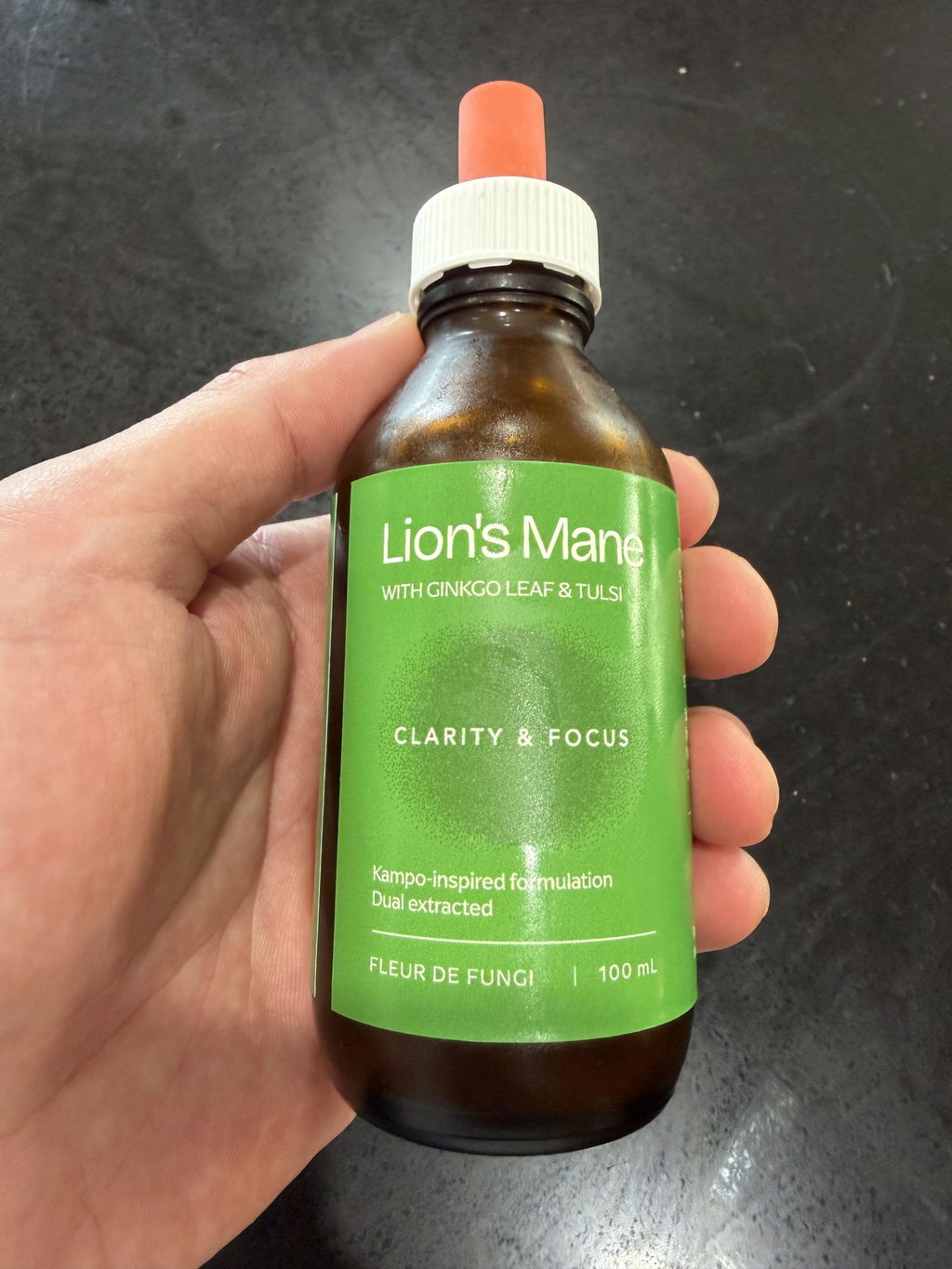
Kampo-inspired extract · 100 ml
Lion's Mane
with Astragalus, Gotu Kola & Ginkgo Leaf
A liquid tincture drawing on centuries of traditional herbal practice. Each herb is extracted separately to preserve the breadth of its natural compound profile before blending into a single daily formula.
- Australian-grown Lion's Mane fruiting bodies
- Small-batch dual-extracted mushrooms
- No fillers or artificial additives
Dispatched next business day via Auspost
About this formula
Lion's Mane, Astragalus, Gotu Kola, and Ginkgo Leaf each carry their own long-standing reputation across the traditions they come from, from foundational Chinese tonic herbs to plants associated for centuries with study and steady daily practice. Inspired by Kampo philosophy, this formula brings them together as a considered whole, not as isolated ingredients.
Lion's Mane
Hericium erinaceus
Known as Hou Tou Gu in traditional Chinese practice, Lion's Mane has been recorded in East Asian texts for centuries. It became closely associated with monks and scholars, earning a lasting place in traditions centred on learning, reflection, and contemplative life.
Astragalus
Astragalus membranaceus
Astragalus root has stood among the most trusted herbs in Chinese medicine for two thousand years, first recorded in the Shennong Ben Cao Jing and placed in its highest class, reserved for herbs safe enough for daily, lifelong use. Classical physicians built entire formulas around it as the principal Qi tonic, its role always to reinforce, never to dominate.
Gotu Kola
Centella asiatica
Classified in Ayurvedic tradition as a Medhya Rasayana, Gotu Kola has been associated for centuries with study, memory, and steady daily practice, historically taken by students committing long texts to memory. Its use spans Ayurvedic and East Asian herbal tradition alike, traditionally prepared as a fresh leaf juice or included in daily tonic preparations.
Ginkgo Leaf
Ginkgo biloba
One of the oldest surviving tree species on Earth, Ginkgo has been planted around temples and sacred sites throughout East Asia for more than a thousand years. Its remarkable longevity made it a symbol of endurance and wisdom across generations.
Extraction method
Why extraction method matters
Lion's Mane undergoes two separate extraction passes, one in hot water and one in alcohol, before being combined. Its naturally occurring compounds are not all soluble in the same solvent.
Water-soluble compounds
Hot water extraction captures naturally occurring water-soluble compounds, including polysaccharides and beta-glucans, traditionally present in decoctions and teas across East Asian herbal practice.
Alcohol-soluble compounds
Alcohol extraction captures hericenones, terpenes, and other naturally occurring compounds that are less soluble in water and may not be represented in a water-only extraction. Combining both extraction methods provides a broader representation of the mushroom's naturally occurring compound profile.
Astragalus, Gotu Kola and Ginkgo Leaf - hot water extracted
All three companion herbs are extracted using hot water, consistent with the traditional preparation methods in which they have been used for centuries.
How to use
Your daily practice
Serve
1-2 ml daily
One to two full droppers. Start with one and adjust to preference. At 2 ml daily, one bottle lasts 50 days.
How to take
Morning routine
Easiest to build into a morning routine - water, coffee, or your drink of choice.
Consistency
Daily practice over time
Traditional herbal use is built on consistent, sustained practice, not single use.
Rooted in tradition
Kampo philosophy
Kampo is the Japanese adaptation of classical Chinese medicine, refined over centuries into a system of compound herbal formulas rather than single-herb treatments. Its philosophy holds that herbs in combination, chosen for their complementary qualities, reflect the whole more fully than any one ingredient alone.
This formula draws on that thinking. Each ingredient has its own long history in East Asian and Ayurvedic practice, brought together here because their traditions converge on similar values: sustained engagement, inner steadiness, and daily ritual as a form of care.
A daily herbal practice is not a shortcut. It is a discipline, something done consistently, with attention, over time.
Fleur de FungiThis product is a traditional botanical preparation, crafted to be enjoyed as part of everyday life. It is not a medicine or therapeutic good. Always read the label and use as directed.
I’ve been taking this daily for about a month now. I’ve noticed I can concentrate for longer stretches, and I’m thinking more creatively, with ideas connecting more easily than before. It’s genuinely improved my day to day life.
I have been using the Lion’s Mane extract and really enjoying it. I feel clearer through the day and find it easier to stay focused on what I need to get done.
I came back to tell Martin how much I’m enjoying the Lion’s Mane extract. I feel more clear-headed during the day and seem to stay focused for longer.
I really been enjoying the Lion’s Mane extract. I feel more switched on during the day and find it easier to focus and plan things ahead